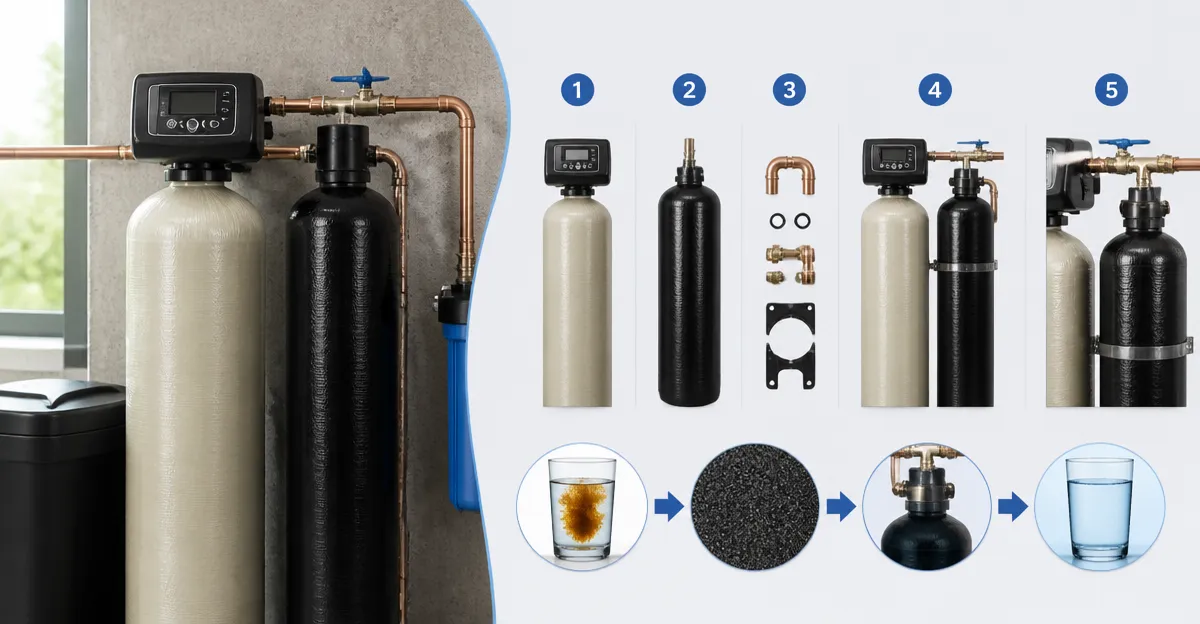
How to Convert a Fleck or Culligan Water Softener to Treat Low‑Level Iron with an Inline Catalytic Carbon Stage — Step‑by‑Step Retrofit Guide
Introduction
One often discovers that a conventional ion‑exchange softener does not address low‑level iron that causes staining, metallic taste, or premature appliance wear. By adding an inline catalytic carbon stage, the system can remove iron, chloramine, and other undesirable compounds while preserving the softening function. This guide explains precisely how to retrofit a Fleck or Culligan water softener with a catalytic carbon cartridge, why each component is selected, and how to verify successful operation. The information is valuable for homeowners who wish to extend the life of their plumbing, improve skin and hair health, and reduce maintenance costs without replacing the entire softening unit.
What You Will Need
- Adjustable wrenches and pipe‑cutting tools
- Ball valve or 1‑inch bypass valve (often supplied with the softener)
- Inline filter housing compatible with 10" × 2.5" cartridges
- Envig Catalytic Carbon Filter Cartridge – 10" × 2.5" cartridge, 4‑layer media, $31.99, rating 4.4/5
- LiquaGen Whole House Water Filter – optional pre‑filter for larger homes, $879.99, rating 4.5/5
- Plumber’s Teflon tape and pipe thread sealant
- Bucket for draining water
- Digital pressure gauge (optional but recommended)
Step 1: Shut Off Water Supply and Power
One should begin by turning off the main water supply to the residence and disconnecting power to the softener control unit. Locate the service valve near the water meter, rotate it clockwise until it stops, and open a downstream faucet to relieve pressure. After the pressure is relieved, unplug the softener or turn off the dedicated circuit breaker. This precaution prevents accidental water discharge and protects the electronic control board during the retrofit.
Step 2: Install a Bypass Configuration
To allow continued water flow while the cartridge is being installed, one must create a bypass loop. If the softener already includes a 1‑inch metal bypass valve, attach it to the existing inlet and outlet ports using the supplied fittings. If a bypass valve is not present, install a standard ball valve in parallel with the softener’s inlet line. Secure all connections with Teflon tape to ensure a leak‑free seal. The bypass arrangement enables one to isolate the softener for cartridge installation without interrupting water service to the rest of the house.
Step 3: Choose the Appropriate Inline Catalytic Carbon Cartridge
The catalytic carbon stage must be capable of reducing iron, chloramine, and hydrogen sulfide while maintaining adequate flow. The Envig Catalytic Carbon Filter Cartridge offers a four‑layer design that includes a 5‑micron sediment pre‑filter, high‑performance catalytic carbon, KDF55 media, and a final sediment layer. Its 2.5 gallon‑per‑minute flow rate aligns with typical residential softener capacities, and the cartridge is rated for up to 8,000 gallons before replacement. Compared with larger whole‑house units, this cartridge provides a cost‑effective, space‑saving solution that can be swapped during routine maintenance.
Step 4: Install the Inline Filter Housing
One should position the inline housing on the main supply line upstream of the softener, ideally within the bypass loop for easy access. Cut the pipe at the designated location, remove any burrs, and install the housing using the supplied compression fittings. Apply Teflon tape to the threaded ends, then tighten the fittings with an adjustable wrench. Insert the Envig Catalytic Carbon Filter Cartridge into the housing, ensuring the flow direction arrow points toward the softener. Close the housing lid securely; most housings feature a quick‑release latch that does not require additional tools.
Step 5: Reconnect the Softener and Verify Flow
After the housing is installed, one must reconnect the softener to the main line by closing the bypass valve. Slowly open the main water supply and observe the pressure gauge for any abnormal drop. If the pressure remains within the manufacturer’s recommended range (typically 40–80 psi for Fleck and Culligan units), the installation is successful. Turn the softener power back on and allow the control unit to complete its start‑up cycle.
Step 6: Program the Softener for Low‑Level Iron
Fleck and Culligan controllers include a setting for iron removal that adjusts regeneration frequency and salt dosage. Access the programming menu, navigate to the “Iron” or “Heavy Metals” option, and select the low‑level iron mode (often labeled 0‑2 ppm). Set the regeneration interval to 7‑10 days, depending on water usage, and confirm the changes. The catalytic carbon stage will handle the bulk of iron oxidation, while the ion‑exchange resin will capture any remaining dissolved iron that passes through.
Step 7: Test Water Quality and Adjust Settings
One should collect a water sample from a kitchen faucet after the system has run for at least 30 minutes. Use a simple iron test kit to verify that iron concentrations have dropped below 0.3 ppm, the threshold at which most stains become invisible. If the iron level remains higher, consider increasing the regeneration frequency or adding a small amount of food‑grade polyphosphate to the pre‑softener line to keep iron particles in suspension for easier removal. Re‑test after any adjustment to confirm improvement.
Tips & Pro Tips
- Schedule the automatic backwash feature of the softener to run after each regeneration; this helps flush any iron particles that may have settled in the resin bed.
- When replacing the catalytic carbon cartridge, inspect the housing O‑rings for wear and apply a thin layer of silicone lubricant to extend their service life.
- For homes with higher flow demands, the LiquaGen Whole House Water Filter can be installed upstream of the softener to pre‑filter sediment and protect the catalytic carbon cartridge from premature clogging.
- Document the installation date and cartridge serial number; this information simplifies future maintenance and warranty claims.
Troubleshooting
Problem: Reduced water pressure after installation.
Solution: Verify that the filter housing is not installed in reverse; the flow direction arrow must point toward the softener. Check for debris trapped in the housing screen and clean if necessary.
Problem: Persistent iron staining despite low measured iron levels.
Solution: Iron may be present as particulate rather than dissolved. Adding a small amount of polyphosphate or installing a dedicated sediment pre‑filter can capture these particles before they reach the softener.
Problem: Cartridge life appears shorter than the advertised 8,000 gallon rating.
Solution: Water with high chlorine or chloramine content can accelerate media exhaustion. Consider pairing the cartridge with the Home Master Big Blue Carbon Filter as a secondary stage to handle excess chlorine, thereby extending the primary cartridge’s lifespan.
Conclusion
One can successfully retrofit a Fleck or Culligan water softener to treat low‑level iron by adding an inline catalytic carbon stage. The process involves shutting off water, installing a bypass, selecting a suitable cartridge such as the Envig 4C model, integrating it into the supply line, programming the softener for iron removal, and verifying performance with simple testing. By following the steps outlined in this guide, homeowners will enjoy clearer water, reduced staining, and longer appliance life while maintaining the benefits of ion‑exchange softening.
Frequently Asked Questions
Can a standard Fleck or Culligan softener remove low‑level iron on its own?
No, typical ion‑exchange softeners only address hardness; low‑level iron requires an additional filtration stage.
What is the purpose of adding an inline catalytic carbon cartridge?
The carbon stage adsorbs iron, chloramine, and other contaminants while allowing the softener to continue removing hardness.
Do I need special tools to retrofit the softener with a carbon filter?
Basic plumbing tools such as adjustable wrenches and a pipe‑cutter are sufficient, plus a compatible 10"×2.5" filter housing.
Will the retrofit affect the softener’s regeneration cycle?
No, the carbon cartridge is installed in the bypass line and does not interfere with the softener’s programmed regeneration.
How can I verify that the iron removal is working after installation?
Test the water for iron before and after the filter, or check for the absence of staining and metallic taste during normal use.