Introduction
One will find that a well water treatment maintenance contract is a critical document that protects both the homeowner and the service provider. This guide explains the scope of such a contract, the essential clauses, and the practical steps required to keep a private well operating safely. Readers will learn how to define service frequency, performance metrics, filter replacement schedules, compliance requirements, and documentation procedures. In addition, the guide recommends proven filtration products that align with the maintenance objectives.
Background and Context
Well water systems differ from municipal supplies because they draw water directly from underground aquifers. Consequently, the water may contain sediment, iron, manganese, bacteria, and variable mineral content. A maintenance contract ensures that the system is inspected, cleaned, and serviced on a regular basis to prevent equipment failure and health risks. Regulatory agencies often require records of water quality testing and filter changes, making documentation a core component of any agreement.
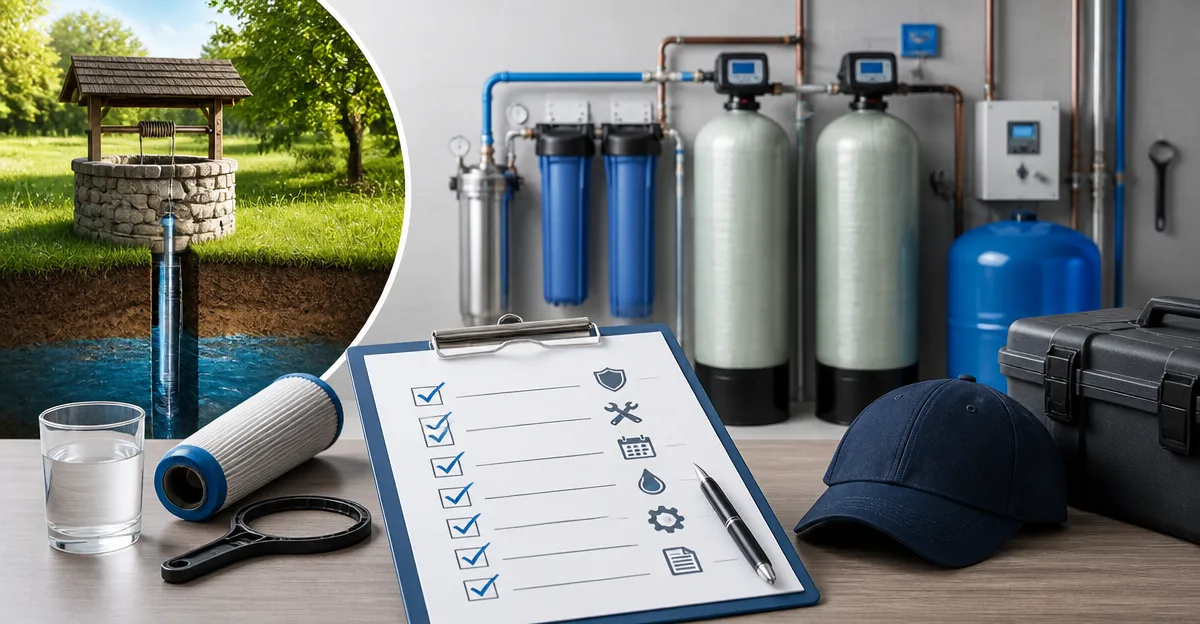
One should understand the typical components of a well water treatment system: a pump, pressure tank, pre‑filter, sediment filter, carbon or catalytic filter, and sometimes a softener or reverse‑osmosis unit. Each component has a service life that can be extended through proper maintenance. The contract must therefore address each element separately while providing a clear escalation path for unexpected issues.
Key Components of a Well Water Treatment Maintenance Contract
1. Scope of Services
The contract must list all services that the provider will perform. Typical items include visual inspection of the well cap, pump performance testing, pressure tank evaluation, filter inspection and replacement, disinfecting the system, and water quality testing for bacteria, pH, and total dissolved solids (TDS). By enumerating each task, both parties avoid misunderstandings about responsibilities.
2. Service Frequency and Performance Metrics
Service intervals are usually based on water usage, water quality, and equipment specifications. For sediment‑heavy well water, a quarterly inspection is advisable, whereas a system that includes carbon filtration may require semi‑annual testing for chlorine reduction. The contract should define measurable performance metrics such as flow rate (gallons per minute), pressure loss across filters, and acceptable TDS ranges.
3. Filter Replacement Schedule
Filters constitute the most consumable part of a treatment system. The contract must specify the type of filter, its micron rating, and the recommended replacement interval. For example, the PurePlus Whole House Water Filter is a 5‑micron sediment filter designed for well water, capable of handling up to 30,000 gallons and lasting 3‑6 months in average households. Similarly, the PurePlus Pleated Sediment Filter offers a larger filtration area and can maintain flow rates of up to 2.5 GPM for the same service life. Including these specifications in the contract helps the homeowner budget for filter purchases and ensures that the service provider replaces the correct model.
4. Compliance and Documentation
Regulatory compliance requires that the service provider retain records of each visit, including test results, filter serial numbers, and any corrective actions taken. The contract should mandate that the provider deliver a monthly or quarterly report, and that the homeowner retain a copy for future reference. Digital signatures and cloud‑based storage are recommended for ease of access.
5. Pricing, Payment Terms, and Termination
Clear financial terms prevent disputes. The contract should outline the base service fee, the cost of consumables such as filters, and any travel or emergency charges. It is advisable to include a price‑adjustment clause tied to inflation or changes in material costs. Termination provisions must describe the notice period, any prorated refunds, and the process for returning equipment.
Product Recommendations Integrated with Contract Clauses
When drafting the filter replacement schedule, one may reference the following products, each of which meets the 5‑micron specification required for most well‑water sediment removal.
- PurePlus Whole House Water Filter – A 5 micron, 10 × 4.5 inches filter that reduces up to 99 % of sediment, sand, and rust. It is compatible with a wide range of standard housings, including GE GXWH30C and Culligan HD‑950. Price: $29.99, Rating: 4.8/5 (2,535 reviews).
- PurePlus Pleated Sediment Filter – Utilizes a pleated design to increase surface area, maintaining high flow while capturing fine particles. It also supports up to 30 000 gallons before replacement. Price: $29.99, Rating: 4.7/5 (3,890 reviews).
- PurePlus Sediment & Carbon Filter – Combines a 5 micron sediment layer with coconut‑shell activated carbon, suitable for tap water but less effective for well water. It is priced at $30.99 with a 4.7/5 rating (7,970 reviews).
- IcePure CTO Carbon Water Filter – A 1 micron carbon‑only filter designed for chlorine removal in municipal water; not recommended for sediment‑rich well water. Price: $26.99, Rating: 4.6/5 (6,431 reviews).
- PurePlus 1‑Stage Whole House Filter – A comprehensive system that can accommodate various cartridge types, including sediment and carbon. It is priced at $78.99 with a 4.4/5 rating (186 reviews).
These items can be listed in the contract as approved consumables, ensuring that the service provider uses certified components that meet ISO 9001 and ISO 14000 quality standards.
Comparison and Selection Guide
| Product | Micron Rating | Capacity (gallons) | Primary Use | Price | Rating |
|---|---|---|---|---|---|
| PurePlus Whole House Water Filter | 5 µm | 30 000 | Well water sediment removal | $29.99 | 4.8 |
| PurePlus Pleated Sediment Filter | 5 µm | 30 000 | Well water sediment removal with higher flow | $29.99 | 4.7 |
| PurePlus Sediment & Carbon Filter | 5 µm (sediment) + carbon | 30 000 | Tap water chlorine and sediment | $30.99 | 4.7 |
| IcePure CTO Carbon Filter | 1 µm | 13 000 | Municipal water chlorine removal | $26.99 | 4.6 |
| PurePlus 1‑Stage Whole House Filter | Variable (depends on cartridge) | Varies | Customizable whole‑house solution | $78.99 | 4.4 |
One should select a filter based on the well’s sediment load, desired flow rate, and whether additional chlorine removal is required. For high‑sediment wells, the PurePlus Whole House Water Filter or the Pleated Sediment Filter are the most appropriate choices because they maintain flow while capturing fine particles.
Best Practices and Tips for Contract Management
- Define a clear escalation path for emergency repairs, including after‑hours contact numbers.
- Schedule water quality testing at least twice a year and attach the results to the contract file.
- Include a clause that requires the service provider to use only ISO‑certified filters, such as the PurePlus models listed above.
- Perform a visual inspection of the well cap and pump area during each service visit to detect corrosion or animal intrusion.
- Maintain a spare set of filters on site to avoid downtime between service visits.
- Review the contract annually to adjust service frequency based on observed water quality trends.
Frequently Asked Questions
What frequency of filter replacement is optimal for a typical well?
Most experts recommend replacing 5‑micron sediment filters every 3‑6 months, depending on water usage and measured pressure loss. The PurePlus Whole House Water Filter, for example, is rated for up to 30 000 gallons, which often corresponds to a 4‑month interval for an average household.
Can a carbon filter be used on well water?
A carbon filter such as the PurePlus Sediment & Carbon Filter is effective for chlorine removal in municipal water but may not provide sufficient protection against the larger particles found in well water. For well water, it is advisable to install a sediment pre‑filter before the carbon stage.
How does one verify that a filter meets the contract’s quality standards?
All PurePlus filters are produced under ISO 9001 and ISO 14000 standards and undergo 400 PSI pressure testing, 10 000 water‑hammer tests, and six independent inspections. The contract should reference these certifications as proof of compliance.
What documentation is required after each service visit?
The service provider should deliver a report that includes date of service, technician name, filter serial numbers, flow rate measurements, pressure readings, and any water‑quality test results. Digital copies stored in a cloud folder are acceptable.
Is it necessary to include a clause for emergency shut‑off procedures?
Yes. The contract should describe the location of the main shut‑off valve, the steps to isolate the system, and the contact information for emergency response. This protects both the homeowner and the provider in the event of a sudden pump failure or contamination event.
Conclusion
One can ensure the longevity and safety of a private well by establishing a comprehensive maintenance contract that addresses scope, frequency, filter replacement, compliance, and financial terms. Selecting certified filtration products such as the PurePlus Whole House Water Filter or the PurePlus Pleated Sediment Filter aligns the contract with industry‑proven performance standards. By following the best‑practice checklist and documenting each service, homeowners protect their investment and maintain high‑quality water for their families.
Products Featured in This Guide
PurePlus Whole House Water Filter
Price: $29.99 | Rating: 4.8/5 (2,535 reviews)
Featured because it provides 5‑micron sediment removal for well water, supports up to 30 000 gallons, and complies with ISO quality standards.
PurePlus Sediment & Carbon Filter
Price: $30.99 | Rating: 4.7/5 (7,970 reviews)
Featured for its dual‑stage design that removes sediment and chlorine, suitable for tap water systems where additional carbon treatment is desired.
PurePlus Pleated Sediment Filter
Price: $29.99 | Rating: 4.7/5 (3,890 reviews)
Featured because its pleated construction offers larger filtration area, maintaining high flow rates while capturing fine particles in well water.
IcePure CTO Carbon Water Filter
Price: $26.99 | Rating: 4.6/5 (6,431 reviews)
Featured as a high‑efficiency carbon filter for chlorine removal in municipal water; included for comparative purposes when a homeowner transitions from well to city supply.
PurePlus 1‑Stage Whole House Filter
Price: $78.99 | Rating: 4.4/5 (186 reviews)
Featured for its customizable housing that accepts multiple cartridge types, allowing homeowners to tailor the system to specific well‑water challenges.