Introduction
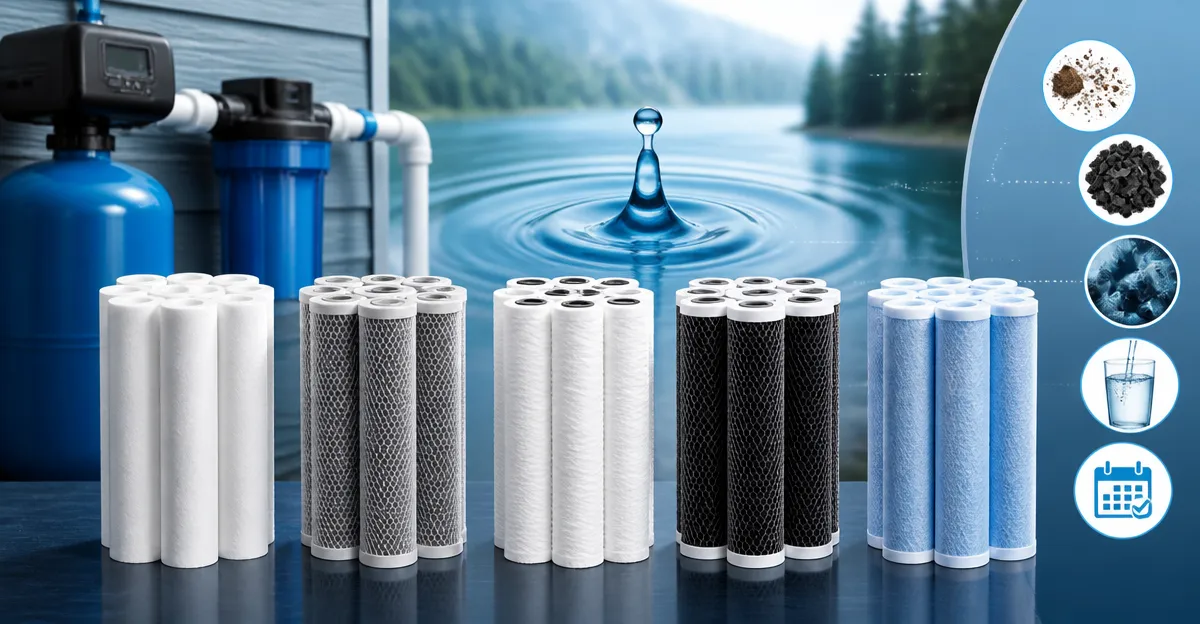
Homeowners who rely on well water or municipal supply often install a pre‑filter to protect downstream appliances and improve drinking quality. The market offers many 10‑inch by 2.5‑inch cartridges, yet subtle differences in material, flow capacity, and certifications can affect long‑term value. This article compares five popular Amazon listings—Aquaboon Sediment Filter, Membrane Solutions Sediment Filter, Pureplus CTO Carbon Filter, ICEPURE CTO Carbon Filter, and AquaWeaver Sediment Filter—using only the data supplied. By examining price, specifications, customer feedback, and real‑world performance, readers can select the filter that best matches their water conditions and budget.
Individual Product Overviews
Aquaboon Sediment Filter
The Aquaboon 5‑micron sediment filter is a 6‑pack designed for whole‑house systems. Constructed from food‑grade polypropylene, it promises no fiber shedding and a stable flow with no pressure drop. At $23.79 it holds a 4.7‑star rating from 5,555 reviews. Positive reviewers note, "The 5‑micron rating means they can effectively capture even very fine sediment particles," and they praise the universal fit and durability.
Membrane Solutions Sediment Filter
Membrane Solutions offers a string‑wound 5‑micron cartridge with a claimed four‑times higher dirt‑holding capacity and double the flow rate of standard polypropylene filters. Priced at $26.35, it also carries a 4.7‑star rating from 5,237 reviewers. Users highlight its "excellent job of trapping dirt, sand, and sediment" and appreciate the flat packaging that stays clean until installation.
Pureplus CTO Carbon Filter
Pureplus provides a 1‑micron carbon‑block filter in a 4‑pack for post‑sediment treatment. Certified against NSF/ANSI 42, it removes 99 % of chlorine and odor. The price is $29.99 and the rating is 4.6 stars from 7,700 reviews. Customers commend its "great quality" and note the "easy replacement" process.
ICEPURE CTO Carbon Filter
ICEPURE’s 1‑micron carbon filter also targets chlorine, taste, and odor, with NSF/ANSI 42 certification and a lifespan of up to 13,000 gallons. It is priced at $29.99 and holds a 4.6‑star rating from 6,312 reviewers. Reviewers describe the water as "clear, tastes great" and appreciate the leak‑free design.
AquaWeaver Sediment Filter
AquaWeaver’s 5‑micron cartridge is the most affordable at $19.79, earning a 4.8‑star rating from 95 reviews. The filter is food‑grade polypropylene, EU RoHS and FDA certified, and claims a high dirt‑holding capacity lasting up to 6 months or 13,000‑20,000 gallons. Users appreciate the "half the price of other name brand filters" and the quick installation.
Head‑to‑Head Comparison
- Price and Value: AquaWeaver is the cheapest at $19.79 for six cartridges, while Pureplus and ICEPURE are $29.99 for four carbon cartridges. Membrane Solutions sits in the middle at $26.35 for six sediment cartridges. Aquaboon offers the best price‑per‑cartridge ratio for sediment filters ($3.96 each).
- Features and Specifications: All sediment filters share a 5‑micron rating and universal 10×2.5 size. Membrane Solutions differentiates with a string‑wound design that claims four‑times higher dirt capacity and double flow rate. Aquaboon emphasizes melt‑blown construction and continuous flow with no pressure drop. AquaWeaver highlights EU RoHS, FDA, and Proposition 65 certifications. Carbon filters (Pureplus, ICEPURE) add chlorine reduction, NSF/ANSI 42 certification, and coconut‑shell activated carbon.
- Customer Ratings and Feedback: AquaWeaver leads with 4.8 ★ from 95 reviews, though the sample size is small. Aquaboon and Membrane Solutions both hold 4.7 ★ from over 5,000 reviews, indicating broad satisfaction. Pureplus and ICEPURE each have 4.6 ★ from 7,700 and 6,312 reviews respectively, reflecting solid but slightly lower enthusiasm.
- Performance and Reliability: Reviewers of Aquaboon note "no pressure drop" and consistent flow. Membrane Solutions users report "longer service life" and "does not clog as fast." AquaWeaver’s high dirt‑holding claim is supported by comments such as "works fine at half the price of other name brand filters." Carbon filters excel at taste improvement; Pureplus users say "cleaner water experience" while ICEPURE reviewers mention "water is clear, tastes great."
- Best Use Cases:
- Well water with high sediment: Membrane Solutions or AquaWeaver for high capacity.
- Municipal water needing chlorine removal: Pureplus or ICEPURE carbon filters.
- Budget‑conscious whole‑house pre‑filter: Aquaboon or AquaWeaver.
- Systems requiring minimal pressure loss: Aquaboon.
Comparison Table
| Product | Type | Micron Rating | Pack Size | Price (USD) | Rating | Key Advantage |
|---|---|---|---|---|---|---|
| Aquaboon Sediment Filter | Sediment | 5 µm | 6‑Pack | 23.79 | 4.7 ★ (5,555) | No pressure drop, food‑grade melt‑blown material |
| Membrane Solutions Sediment Filter | Sediment (string‑wound) | 5 µm | 6‑Pack | 26.35 | 4.7 ★ (5,237) | 4× dirt capacity, 2× flow rate |
| Pureplus CTO Carbon Filter | Carbon (CTO) | 1 µm | 4‑Pack | 29.99 | 4.6 ★ (7,700) | NSF/ANSI 42 certified, coconut‑shell carbon |
| ICEPURE CTO Carbon Filter | Carbon (CTO) | 1 µm | 4‑Pack | 29.99 | 4.6 ★ (6,312) | Leak‑free design, 99 % chlorine removal |
| AquaWeaver Sediment Filter | Sediment | 5 µm | 6‑Pack | 19.79 | 4.8 ★ (95) | EU RoHS & FDA certified, highest dirt capacity |
Pros & Cons
Aquaboon Sediment Filter
- Pros: Low price per cartridge, melt‑blown construction prevents fiber shedding, maintains water pressure.
- Cons: No independent NSF certification mentioned; performance data limited to manufacturer claims.
Membrane Solutions Sediment Filter
- Pros: String‑wound design offers higher dirt‑holding capacity and faster flow; NSF/ANSI 42 material certification.
- Cons: Slightly higher price; bulkier packaging may be less convenient.
Pureplus CTO Carbon Filter
- Pros: Certified against NSF/ANSI 42, coconut‑shell carbon provides strong chlorine removal, ISO‑9001 quality control.
- Cons: Higher cost per cartridge; limited to post‑sediment use.
ICEPURE CTO Carbon Filter
- Pros: Leak‑free multi‑dimensional sealing, third‑party heavy‑metal testing, long lifespan up to 13,000 gallons.
- Cons: Not optimized for high‑sediment well water; may clog faster in such conditions.
AquaWeaver Sediment Filter
- Pros: Lowest overall price, strong certifications (EU RoHS, FDA), high dirt‑holding capacity, compatible with many brands.
- Cons: Small review base (95); limited third‑party testing details.
Recommendations
Based on the data, the following recommendations are offered:
- Best budget pre‑filter for well water: AquaWeaver Sediment Filter – low price, high dirt capacity, and extensive compatibility.
- Best all‑round sediment filter with flow assurance: Aquaboon Sediment Filter – maintains pressure and offers solid value.
- Best high‑capacity filter for heavy sediment loads: Membrane Solutions Sediment Filter – string‑wound design handles more dirt before replacement.
- Best carbon filter for chlorine and taste removal: Pureplus CTO Carbon Filter – NSF/ANSI 42 certification and coconut‑shell carbon.
- Best carbon filter for leak‑free installation: ICEPURE CTO Carbon Filter – multi‑dimensional sealing and heavy‑metal testing.
FAQ
- What does a 5‑micron rating mean?
- A 5‑micron filter can capture particles larger than five millionths of an inch, including rust, sand, and most sediment that causes cloudy water.
- Can I use a sediment filter and a carbon filter together?
- Yes. The typical configuration places a sediment filter first to remove large particles, followed by a carbon filter to eliminate chlorine, taste, and odor.
- How often should I replace a 5‑micron sediment filter?
- Replacement frequency depends on water quality, but most manufacturers suggest every 6‑12 months or after 10,000‑20,000 gallons, whichever occurs first.
- Are the carbon filters safe for well water?
- Both Pureplus and ICEPURE are certified for municipal water. For well water with high sediment, install a sediment pre‑filter to protect the carbon media from clogging.
- Do any of these filters have NSF certification?
- Pureplus and ICEPURE carbon filters are NSF/ANSI 42 certified for chlorine reduction. Membrane Solutions mentions material certification against NSF/ANSI 42 for material requirements only.
- Which filter offers the longest service life?
- Membrane Solutions claims up to 20,000 gallons, while AquaWeaver and Aquaboon state up to 13,000‑20,000 gallons depending on conditions. Carbon filters typically last 13,000 gallons.
Conclusion
The five products examined address distinct needs within a whole‑house water‑treatment system. For households with high sediment loads and limited budgets, AquaWeaver provides the most economical solution without sacrificing certification. Aquaboon offers reliable flow and a low price‑per‑cartridge, making it a solid all‑round choice. When capacity and flow are paramount, Membrane Solutions stands out with its string‑wound design. For chlorine and taste removal, Pureplus delivers NSF‑certified performance, while ICEPURE adds a leak‑free seal and heavy‑metal testing for extra peace of mind. Selecting the appropriate filter depends on water source, desired lifespan, and whether a carbon stage is required.
Products Mentioned in This Review
Frequently Asked Questions
How often should I replace a 5‑micron sediment filter like Aquaboon’s?
Replace it every 6‑12 months or after 2,000‑3,000 gallons, depending on water quality and flow rate.
Are the Aquaboon and Membrane Solutions sediment filters interchangeable?
Yes, both are 10‑inch × 2.5‑inch, 5‑micron polypropylene cartridges, so they fit the same housings.
What’s the main difference between CTO carbon filters and sediment filters?
CTO carbon filters remove chlorine, taste, and odors, while sediment filters trap particles like sand and rust.
Do any of these filters have NSF or ANSI certifications?
Only the Pureplus and ICEPURE CTO carbon filters list NSF/ANSI certifications for contaminant reduction.
Will using a sediment filter affect water pressure in my whole‑house system?
A properly rated 5‑micron filter should maintain stable flow with minimal pressure drop.